Articles, Interviews, Publications
Tactile Sound with Together! 2012 and VibraFusionLab
Blog by Jo Anne Cox for 'Disability Arts Online'
https://disabilityarts.online/blog/jo-anne-cox/tactile-sound-with-together-2012/
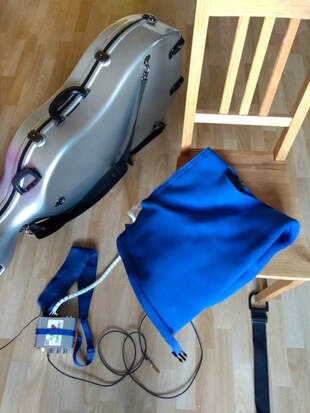
Image Description: A grey cello case rests on a light-coloured wooden floor beside a wooden chair. On the chair is a blue fabric connected to a technological device on the floor.
https://valiz.nl/en/publications/exhibiting-for-multiple-senses
https://www.academia.edu/143773583/Introduction_Exhibiting_for_Multiple_Senses?email_work_card=view-paper
EXHIBITING FOR MULTIPLE SENSES Art and Curating for Sensory-Diverse Bodies
Eva Fotiadi (ed.)
CONTRIBUTORS David Bobier Luca M Damiani Stephanie Farmer & Hettie James Eva Fotiadi David Gissen & Georgina Kleege Adi Hollander Lilian Korner Elke Krasny Renata Pękowska Lotte Lara Schrőder Caro Verbeek
Image Description: Several ameobic-like shapes in soft varying blue colours float on a black background. At the top the words 'Exhibiting for Multiple Senses' appear in large format. In a smaller light blue font are the words 'Eva Fotiadi (ed.). At the bottom are the words 'Plural' and 'Valiz' also in small light blue font.
Eva Fotiadi (ed.)
CONTRIBUTORS David Bobier Luca M Damiani Stephanie Farmer & Hettie James Eva Fotiadi David Gissen & Georgina Kleege Adi Hollander Lilian Korner Elke Krasny Renata Pękowska Lotte Lara Schrőder Caro Verbeek
Image Description: Several ameobic-like shapes in soft varying blue colours float on a black background. At the top the words 'Exhibiting for Multiple Senses' appear in large format. In a smaller light blue font are the words 'Eva Fotiadi (ed.). At the bottom are the words 'Plural' and 'Valiz' also in small light blue font.
HAPTIC VOICES: SLOW TECHNOLOGY IN MOTION
David Bobier & Jim Ruxton
Exhibition Essay by Ecliza Chandler
I have been admiring the haptic works of David Bobier and Jim Ruxton for years. I’m captivated by how they use vibrotactile technology, a transducer-based technology that uses sound to produce vibration. Traditionally used to increase D/deaf and hard-of-hearing people’s access to sound, Bobier and Ruxton work with this technology as a basis for their creative processes in innovating artwork which brings together access and aesthetics.
We are currently living in a moment where access to the arts is fragile. Persisting pandemics, late capitalist inflation, amplifying environmental crises, and increasing racist and colonial state-sanctioned violence makes navigating public spaces and experiencing artworks increasingly risky for many of us. In this climate, accessing art requires new methods. Increasingly, exhibition spaces must include virtual modes of participation to be considered truly barrier-free.
The online and hybrid spaces that we all had become accustomed to in the height of the pandemic have all but disappeared. The technology to provide options for virtual participation is still available, of course, as well as the affordances it provides, such as allowing for the participation of international guests, facilitating people to attend events while performing at-home care work at the same time, and so on. However, it seems as though including Zoom links in our event invitations serve as a reminder of the pandemic that so many are desperate to move past. The trouble is that we leave people behind, including disabled folks and others for whom public space and gathering is risky.
From the backdrop of this shifting cultural landscape, I was intrigued to learn about Bobier and Ruxton’s latest installation, Haptic Voices. The multi-channeled vibrating wall at the centre of this exhibition brings together virtual and in-person audiences. Virtual participants are not simply passive observers to this piece as they often are in hybrid spaces - they actually create the sounds that produce the haptics the in-person audience experiences. Virtual participants can also determine where to locate their vibrations on the wall as well as their levels of intensity. A true cross time/space collaboration.
We might consider this haptic wall an example of what Lars Hallnäs and Johan Redström (2001) term “slow technology.” We often think the role of technology is to improve efficiency as to allow us to better keep up with the demands of capitalism. Emails quicken communication to speed up and increase productivity. Smartphones stretch our workday beyond its usual eight hours. Even Zoom, though often an instrument of remote access, is marketed for its ability to schedule back-to-back meetings and keep us working regardless of snowy weather or scratchy throats. Differently, slow technology encourages us to take time to learn how technology works, why it works, to use it in intended and experimental ways, and to consider the consequences of its use (Hallnäs & Redström, 2001, p. 203). As disability studies scholar Megan Johnson et al (forthcoming) writes, “slow technology is about uniting functionality with aesthetics, and about encouraging a sense of presence and attention.”
In Haptic Voices, Bobier and Ruxton experiment with the technologies of hybridity outside of the ways they are often used. Differently, the artists’ use of vibrotactile technology coincides with the ethics of accessibility as they build an installation and an occasion that brings us together across time, space, and ability to engage in shared experiences. Our togetherness can literally be felt as the sounds one person makes through vocal allocutions, finger taps, deep breaths, and so on generates vibrations that are absorbed by others and turned into something else. The technology that facilitates this haptic collaboration doesn’t require us to show up in any particular embodiment; just being animate and in close proximity to an online computer with a microphone or the vibrating wall is enough. Slow technology doesn’t ask us to use technology as a tool to uniformly achieve a task; it promotes reflection and rest (Hallnäs & Redström, 2001, p. 202; 204; 209). It is up to us, the users of this technology, to reflect on how Haptic Voices changes the meaning of interactions.
Haptic Voices doesn’t require synchroneity; vibrations can either be experienced in real time or, if there aren’t any participants in the gallery when they are produced, they are stored and distributed at a time when people next visit the wall. Haptic Voices doesn’t always, or necessarily, slow things down. Indeed, Hallnäs and Redström are clear that slow technology is not simply intended to slow things down, but to amplify the presence of time (p. 205). The network of technology used to create this installation makes sure we don’t miss each other just because we can’t always be in a space at the same time. In disability culture, we might describe this orientation to temporality as an iteration of crip time. Disability studies scholar Alison Kafer (2013) writes, crip time is “…not just expanded but exploded; it requires reimagining our notions of what can and should happen in time or recognizing how expectations of ‘how long things take’ are based on very particular minds and bodies. [Crip time] challenge[s] normative and normalizing expectations of pace and scheduling. Rather than bend disabled bodies and minds to meet the clock, crip time bends the clock to meet disabled bodies and minds” (p. 27). As Johnson et al (forthcoming) write, “Like with crip time, which may often, but not always or not necessarily, result in a slow temporality, slow technology is about reorienting our experience of time in relation to the environment.”
Working across slow technology and disability culture, Bobier and Ruxton’s installation both affords and encourages reflection on different ways of being together. In moments where gathering is risky, necessary, yet perhaps tentative, and occurs in a world in flux where our relationships with the environment and to each other continue to transform, we need to be innovating and participating in the kinds of being togetherness Haptic Voices facilitates.
Eliza Chandler, May 2023
Works cited
Hallnäs, L., & Redström, J. (2001). Slow technology–designing for reflection. Personal and ubiquitous computing, 5, 201-212.
Johnson, M., E. Chandler, & C. Rice. (forthcoming). Resisting normality: The temporal flows of crip technoscience. Leonardo.
Kafer, A. (2013). Feminist, queer, crip. Indiana University Press.
David Bobier & Jim Ruxton
Exhibition Essay by Ecliza Chandler
I have been admiring the haptic works of David Bobier and Jim Ruxton for years. I’m captivated by how they use vibrotactile technology, a transducer-based technology that uses sound to produce vibration. Traditionally used to increase D/deaf and hard-of-hearing people’s access to sound, Bobier and Ruxton work with this technology as a basis for their creative processes in innovating artwork which brings together access and aesthetics.
We are currently living in a moment where access to the arts is fragile. Persisting pandemics, late capitalist inflation, amplifying environmental crises, and increasing racist and colonial state-sanctioned violence makes navigating public spaces and experiencing artworks increasingly risky for many of us. In this climate, accessing art requires new methods. Increasingly, exhibition spaces must include virtual modes of participation to be considered truly barrier-free.
The online and hybrid spaces that we all had become accustomed to in the height of the pandemic have all but disappeared. The technology to provide options for virtual participation is still available, of course, as well as the affordances it provides, such as allowing for the participation of international guests, facilitating people to attend events while performing at-home care work at the same time, and so on. However, it seems as though including Zoom links in our event invitations serve as a reminder of the pandemic that so many are desperate to move past. The trouble is that we leave people behind, including disabled folks and others for whom public space and gathering is risky.
From the backdrop of this shifting cultural landscape, I was intrigued to learn about Bobier and Ruxton’s latest installation, Haptic Voices. The multi-channeled vibrating wall at the centre of this exhibition brings together virtual and in-person audiences. Virtual participants are not simply passive observers to this piece as they often are in hybrid spaces - they actually create the sounds that produce the haptics the in-person audience experiences. Virtual participants can also determine where to locate their vibrations on the wall as well as their levels of intensity. A true cross time/space collaboration.
We might consider this haptic wall an example of what Lars Hallnäs and Johan Redström (2001) term “slow technology.” We often think the role of technology is to improve efficiency as to allow us to better keep up with the demands of capitalism. Emails quicken communication to speed up and increase productivity. Smartphones stretch our workday beyond its usual eight hours. Even Zoom, though often an instrument of remote access, is marketed for its ability to schedule back-to-back meetings and keep us working regardless of snowy weather or scratchy throats. Differently, slow technology encourages us to take time to learn how technology works, why it works, to use it in intended and experimental ways, and to consider the consequences of its use (Hallnäs & Redström, 2001, p. 203). As disability studies scholar Megan Johnson et al (forthcoming) writes, “slow technology is about uniting functionality with aesthetics, and about encouraging a sense of presence and attention.”
In Haptic Voices, Bobier and Ruxton experiment with the technologies of hybridity outside of the ways they are often used. Differently, the artists’ use of vibrotactile technology coincides with the ethics of accessibility as they build an installation and an occasion that brings us together across time, space, and ability to engage in shared experiences. Our togetherness can literally be felt as the sounds one person makes through vocal allocutions, finger taps, deep breaths, and so on generates vibrations that are absorbed by others and turned into something else. The technology that facilitates this haptic collaboration doesn’t require us to show up in any particular embodiment; just being animate and in close proximity to an online computer with a microphone or the vibrating wall is enough. Slow technology doesn’t ask us to use technology as a tool to uniformly achieve a task; it promotes reflection and rest (Hallnäs & Redström, 2001, p. 202; 204; 209). It is up to us, the users of this technology, to reflect on how Haptic Voices changes the meaning of interactions.
Haptic Voices doesn’t require synchroneity; vibrations can either be experienced in real time or, if there aren’t any participants in the gallery when they are produced, they are stored and distributed at a time when people next visit the wall. Haptic Voices doesn’t always, or necessarily, slow things down. Indeed, Hallnäs and Redström are clear that slow technology is not simply intended to slow things down, but to amplify the presence of time (p. 205). The network of technology used to create this installation makes sure we don’t miss each other just because we can’t always be in a space at the same time. In disability culture, we might describe this orientation to temporality as an iteration of crip time. Disability studies scholar Alison Kafer (2013) writes, crip time is “…not just expanded but exploded; it requires reimagining our notions of what can and should happen in time or recognizing how expectations of ‘how long things take’ are based on very particular minds and bodies. [Crip time] challenge[s] normative and normalizing expectations of pace and scheduling. Rather than bend disabled bodies and minds to meet the clock, crip time bends the clock to meet disabled bodies and minds” (p. 27). As Johnson et al (forthcoming) write, “Like with crip time, which may often, but not always or not necessarily, result in a slow temporality, slow technology is about reorienting our experience of time in relation to the environment.”
Working across slow technology and disability culture, Bobier and Ruxton’s installation both affords and encourages reflection on different ways of being together. In moments where gathering is risky, necessary, yet perhaps tentative, and occurs in a world in flux where our relationships with the environment and to each other continue to transform, we need to be innovating and participating in the kinds of being togetherness Haptic Voices facilitates.
Eliza Chandler, May 2023
Works cited
Hallnäs, L., & Redström, J. (2001). Slow technology–designing for reflection. Personal and ubiquitous computing, 5, 201-212.
Johnson, M., E. Chandler, & C. Rice. (forthcoming). Resisting normality: The temporal flows of crip technoscience. Leonardo.
Kafer, A. (2013). Feminist, queer, crip. Indiana University Press.
WHYNOT THEATRE, space project
https://whynot.theatre/work/space-project/
NAISA (New Adventure In Sound Art)
In this video David Bobier and Jim Ruxton explain their vibro-tactile art installation Haptic Voices and discuss the evolution of their work at VibraFusionLab in Hamilton, Ontario as well as their support for Deaf and Disabled artists.
Haptic Voices is a large scale ten channel vibro-tactile wall with the potential for 10 independent streams of sound signals. Visitors are invited to stand against the wall to experience vibrations that are controlled using an iPad.
Four sound compositions, designed explicitly for the vibro-tactile experience, were commissioned for the wall. The composers include Toronto-based John Gzowski and Ravi Naimpally, Deaf Irish composer Ailís Ní Ríain and Haptic Voices co-creator Jim Ruxton. Using vibration as the final output, Haptic Voices is equally accessible to the Deaf, hard of hearing and able-bodied communities to experience the wall.
Credit for this video to New Adventures in Sound Art and/or refer to their YouTube channel which is NAISATube.